Alexander Wayne recognizes a good opportunity when he sees it. Wayne, a 21-year-old from Dublin, Georgia, is a guitarist for a new band called The Everyday Anthem. Wayne and lead singer Nicholas Pena have hopes of adding members and recording an EP, but their current objective is to find an audience. To do so, Wayne signed up for SoundCloud, a website that allows artists to post their music for others to see.
“It’s really easy to search for a song you like and from there find other artists who are similar to that genre,” Wayne said. “I think that will help us a good bit. We’ve started out with a few covers, and I think that will help people discover us easier.”
Wayne and Pena join a long list of musicians who have used sites like SoundCloud in hopes of being the next Internet idols. For bands like The Everyday Anthem, today’s online world makes spreading music easier than ever. It provides musicians greater odds of recognition, something past generations only dreamed about.
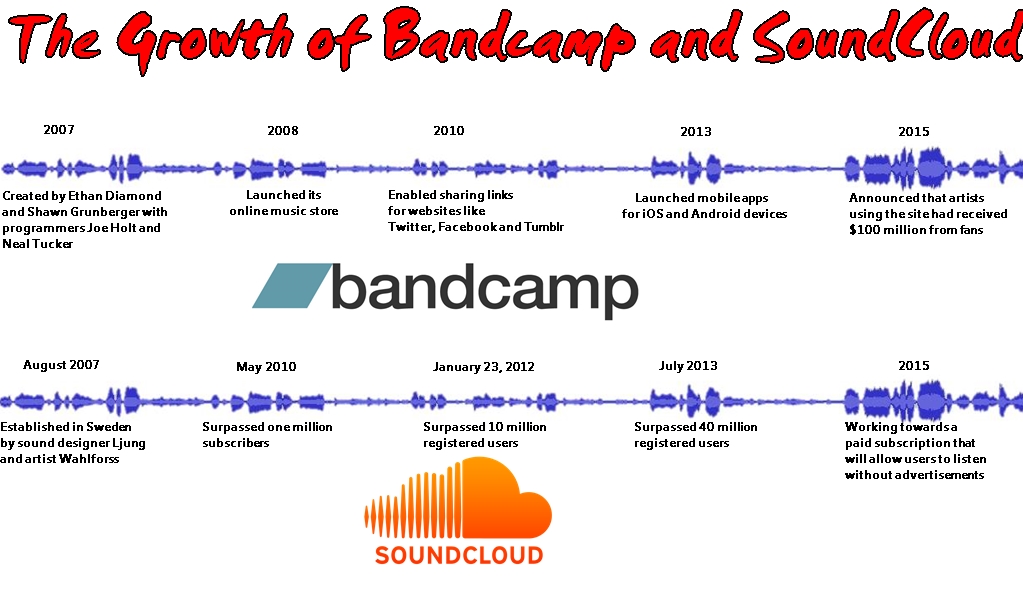
SoundCloud is a popular option among listeners and musicians. The research firm GlobalWebIndex reported in February one out of every 10 online users ages 16 to 64 uses the site at least once a month, with four out of 10 saying they bought a download the month before. Its popularity stems from three advantages: it’s easy, it’s fast and it’s cheap.

Sign up takes little time with few obstacles. Upload time isn’t a hassle, as it can be done in several minutes and is dependent on the track’s length. The site is free up to a certain number of uploads, after which subscriptions of six dollars per month or $15 per month are available. Once the music is uploaded, hashtags can be applied to make discovery easier. For a start-up band like The Everyday Anthem, all it takes is a USB microphone and software like GarageBand to record material suitable for posting.
Competing with SoundCloud as a music streaming service is Bandcamp. The website began in 2007 and offers musicians a free mini site to promote their entire brand. The musician has several options for the site, including charging for downloads, asking for donations and posting a merchandise store. Bandcamp must be doing something right: it announced in March fans had spent $100 million on its musicians.
“It’s a way for artists to put themselves out there and make a statement,” said Tom Walters, who writes a monthly “Best Bandcamp releases” column for DIY Magazine. “Artists can put out whatever music they feel is ready for the open market and share it.”

The internet craze is a digression from the past, when recording studios were the be-all and end-all of music production. Chris Holloway witnesses the change daily. Holloway is the general manager for Omni Sound Studios, which is based in Nashville, Tennessee and has recorded sessions with artists like Taylor Swift, Lionel Richie, Beyoncé and Shakira.
While Holloway acknowledges the surge in users to these websites, he believes there is no competition between the traditional recording studio and the online options.
“A good comparison would be comparing a home movie to a movie that’s done in a studio,” Holloway said. “What makes a song is the acoustics in every portion of the song. You just can’t do much with amateur-type programs.”
The problem for many studios is the price of keeping up is too high today. The rising cost of technology has made it harder to turn a profit, shrinking the market. Holloway estimated Nashville once housed 80 studios but has around 30 today. This evaporating field could leave sites like Bandcamp and SoundCloud with more participation by artists who would have gone to those 50 studios.
The story of Alex Giannascoli shows a happy medium exists between both worlds. A 21-year-old at Temple University, Giannascoli–who uses the stage name Alex G–began using Bandcamp in 2010. After Giannascoli released four albums on his own, Domino Records signed him in September 2014. The company, which boasts musicians like Anna Calvi and the Arctic Monkeys, effectively used Bandcamp as a minor league system of music.
Walters believes the case of Alex G is what users should aspire to.
“I think [Bandcamp] is an entry point,” Walters said. “I don’t think anyone can feasibly sustain themselves with it. It’s genuinely a minefield. You could stumble around for days and not find anything or you get on today and find something that’s fantastic.”
Wayne and Pena are learning firsthand about the beginning stages. With money being tight, the duo is all in on using the simplicity of SoundCloud. All they can do now is produce more tracks, share links, and hope they may be the next Alex G.
 Jordan D. Hill